
Sunday, 17 January 2016
Coursework: Title Sequence

Friday, 1 January 2016
Development of Genre: Thriller
As a group, Naomi, Maddie and I chose to explore the genre of thriller. This research will help us with our coursework as we intend to involve an enigmatic element to our film opening. Genre relies on signs, signifiers, and signifying practices, and this is what will be explored to see how 'thriller' is presented as a genre.
What is a thriller?
A thriller is usually a conflict between a protagonist and an antagonist. A film labelled 'thriller' tends to have a series of unfortunate events that build tension and lead to a climax. Thriller films are also liable to involve disruption of an equilibrium, and include justice in some way, most likely with the protagonist trying to save it, and the antagonist trying to destroy it.


History of Thriller
-1920s-1930s-
· 1926- Alfred Hitchcock “The Lodger”. Jack the Ripper, suspense.
· 1929- Hitchcock “Blackmail”
· 1935 onwards- Majority of Hitchcock’s outputs= thrillers.
· 1928- Fritz Lang “Spies”- Projected the James Bond films of the future.

· 1931- Fritz Lang “German Film”- serial killer Peter Kurten and his life.
· 1933- Edward Sutherland “Murders in The Zoo”.
· NOTABLE BRITISH DIRECTORS: Walter Forde, Victor Saville, George A, Cooper and the young Michael Powell.
-1940s-
· 1940- Hitchcock, suspense thrillers: “Rebecca”, “Foreign Correspondent”
· 1941- “Suspicion”- women in danger of her own husband.
· 1942- “Saboteur”
· 1943- “Shadow of a doubt”, Hitchcock’s personal favourite- based on a true case of a 1920s serial killer known as The Merry Widow Murderer.
· 1944- Psychological thriller “Gaslight”- husband who plotted to make his own Wife go insane in order to inherit her inheritance.
“Noir”- thrilling murder investigation made by police detective.

· 1946- “The Spiral Staircase”
· 1948- “The Lady from Shanghai”, “Sorry, Wrong Number”
· 1949- “The Third Man”
-1950s-
· 1950- Hitchcock, “Technicolor”.
· 1951- Classic film “Strangers On A Train”, staged battle of wits and traded murders with each other.

· 1953- “Niagara”- Henry Hathaway
· 1954- “Dial M for Murder”, about a husband who attempted to murder his wife. “Rear window”- about a man who was convinced his neighbour was a killer.
· 1955- “To Catch a Thief”, “Kiss Me Deadly”, “The Night of The Hunter”
· 1958- “Vertigo”, “Touch of Evil”
-1960s-
· 1960- “Peeping Tom”- psychopathic cameraman- released prior to “Psycho” (1960) - about a loner and a mother fixated motel owner.
· 1962- “Cape Fear” J Lee Thompson- featured a menacing character seeking revenge.
· 1963- “Charade” Stanley Donens- numerous plots and twists starring a pair of characters on the search for hidden loot which takes them to Paris.
· 1965- “Repulsion” Roman Polanski, English- frightening and surrealistic, featured a young woman who goes increasingly mad.

· 1967- “Wait Until Dark” Terrence Youngs- famous thriller of its release date, about a victimized blind woman in her Manhattan apartment and an evil con man in search for drugs.
· Harry palmer Spy trilogy were inspired by 007.
- “The Spy who Came In From The Cold” 1965.
- “The Deadly Affair” + “The Triple Cross”- 1967.
-1970s-1980s-
· 1971- “Duel” , Steven Spielberg, low budget TV movie.

· This period brought the first film about an individual being disturbingly obsessed with their idol. Clint Eastwood’s “Play Misty for Me”
· 1972- Hitchcock, “Frenzy” first British film in almost two decades, given “R” rating for its explicit content. “Deliverance”, John Boorman.
· 1973- “Don’t Look Now”, Nicolas Roegs, macabre- a tale of despair in Venice as a couple grieving the death of their daughter. Brian De Palmas psycho-thriller “Sisters”.
· 1974- “The Conversation” Francis Fords Coppolas (tense thriller).
· 1978- “The Eyes of Laura Mars”
· 1980- “Dressed to kill”
· 1981- “Blow Out”
· 1987- “Body Double”
-1990s-Present-
· 1990- “Misery” Rob Reiners, based on a book by Stephen King.
· 1991- “Sleeping With The Enemy”. “The Silence Of The Lambs”- Jonathan Demme- where a young FBI agent is in a psychological war against a cannibalistic psychiatrist.
· 1992- “The Hand That Rocks The Cradle”, Curtis Hanson- about a nanny who was seeking revenge against her dead husband.

· 1995- “se7en”, David Fincher- about a search for a serial killer who conducted the seven deadly sins.
· 2001- “Joy Ride”.
· 2005- “Hostage”, “A History of Violence”.
· 2006- “Cellular”, “Firewall”.

· 2007- “Captivity”, “P2”.
· 2008- “Eden Lake”, “Funny Games”.
· 2009- “The Last House on the Left”.
· 2011- “Unknown”.
1990's
The Silence of the Lambs (1991)

The colour scheme is a stark black-and-white with highlight of brown and yellow. This also subverts from the modernised norm of red undertones, suggesting that before the 'naughties', the colour scheme associated with thriller films was of a similar essence. The significance of a death's-head hawk moth over the mouth of the victim is important as that particular moth itself carries connotations of death, and the title is of burnt orange colour, encouraging the notion of predators and prey. This idea emphasises the plot which includes psychopathic serial killers and an F.B.I agent, who is cast as a female, consequently being portrayed as a vulnerable character. The face in the background is lit from one side, resulting in the shadows being harsher on the right-hand side, implying that the unnamed person could schizophrenic, which is common amongst the 'bad guys' as they are less predictable.
Leon (1994)

The black background implies a sinister aspect to the film, and the juxtaposition of the white man drawn abstractly implies that this character prefers things simple and clear. It could also be inferred in the sense that because he is an assassin, he cannot afford to go wrong, demonstrated by the sharp contrast and lack of blurred lines/shading.The title is in bold, capital letters bar the letter 'n', which is in lower case; this may indicate that even though everything about the characters lives appears to be in order, there is still the twist of the orphaned girl learning to be an assassin, which is not normal, therefore being a disruption of the equilibrium. This further heightens the thrill and fear that is induced in the audience by the idea of emotionless psychopathy due to the girl and the man looking at the gun in a nonchalant way in the top right corner. Apart from this screenshot, the only other colour on the poster is the word 'Leon', which is in a dull yellow colour, subverting from the typical red highlights that are used in thriller films.

The cool colour scheme and the elongated shadows imply a mysterious element to the film. The faces of the main three characters are pictured in the top half of the film art and they are arranged in a slanted triangular formation, which may indicate a hierarchy amongst those three characters. The man on the right of the three is wearing sunglasses, suggesting that he does not want his identity known, that he wants to blend in with the crowd, and this supports his character as Robert De Niro plays Neil McCauley, who is the head of the criminal crew.The title is of the same sort of colours as the background but it is underlined in red, consequently emphasising it which may imply imminent danger. The five silhouetted figures are stood in a falsely relaxed manner as they are obviously on edge, best represented by the figure on the far left who is looking over his shoulder.
2000's

Momento (2002)
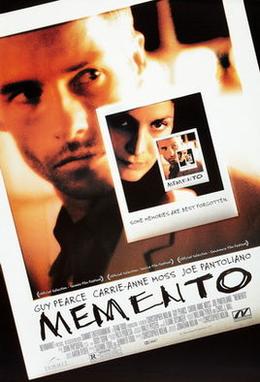
The poster for the thriller film, 'Momento' show a series of photos inside of each other in a cyclical way. This element of the poster adds to the storyline given and suggests a way that the main character overcomes his lack of short term memory and inability to create new ones. The photos are set at a dutch angle, implying a sense of disorientation that may be a reoccurring feature throughout the film. The photos have been filtered so that there are no cool colours involved, with burnt oranges being the main colour. This can be associated with action and a fast paced storyline. In order to make the title stand out, the creator of the poster has used a font which looks like it could be someone's handwriting and is in all capitals, making it even more noticeable as this tends to be identified with anger, panic or just someone trying to emphasise a certain point.
The Departed (2006)

'The Departed' uses a slightly different technique to draw in the audience; it uses a black background and the only image is inside the text of the main title. The text shows close up shots of faces of three men, all with intense facial expressions and the colours are cooler in the images. There are, however, connotations of red which signify danger and blood which may foreshadow events in the film. The title is also repeated on the poster, once in large, block-capitals filled out with coloured images, whereas the other time it appears on the poster is in a plain white, clearer text which is smaller than the other title, but is still larger than the 'fine print'. The text is has no clear layout and is broken up in some places, suggesting that the film is quick and shows an element of uncertainty which is then juxtaposed by the style of the text.
Inception (2010)

The poster for the film, 'Inception' is made up of entirely cool colours, bar the title of the film which is in red. The red has connotations of danger and death, and the simple, capitalised text adds to the atmosphere of fear and the task that the main character has to complete is as far from simplicity as it can get. The background of the media text is a city which appears to be folding in on itself, giving the audience a hint as to what challenges the characters have to face. Having Leonardo DiCaprio as the main character, made clear by him being stood centre shot and the light source coming from behind him, is a good selling point as he has a large fan base and is known to be associated with romance or action films and by looking at this film poster, the audience can tell it is not primarily a romantic story.
The Grey (2011)

This film poster stays relevant to the title when regarding the colour as the colours are slightly washed out, giving it an overall greying effect. The image in the background is a close up of the main character with a determined expression on his face. The injury on the character's face induces the idea of a thriller as it contrasts the rest of the colours dramatically. The text is of a whit, block-capital style which is harsh against the background image, consequently drawing attention to the title. Underneath the main title of the film there is a caption, "live or die on this day", and this provokes the audience into thinking about the film in further detail. This caption also is an exposition for the film, resulting in the audience being on edge and expecting the worst the whole way through the film.
Wednesday, 2 December 2015
Shutter Island Opening Credit Sequence Analysis

 The credits of a scene begin with a slow fade into a dimly lit corridor, complimented with a dark , suspenseful and marked non-diegetic score which begins to create tension, this is coupled with the blood red, Gothic stylized font. The text in itself is used to convey the genre to the audience, the mix of the unsettling, stereotypical font colour and the red tinge the letters have immediately imply the film is a thriller/horror movie. The prominence of the text is instantly displayed due the dim lighting the audience's attention is drawn to it immediately drawn to it.


A quick fade is used again and fades to a close up shot of a hand struggling to move a tile. The identity of the person remains hidden, and the tension that the hand has to the tile alludes some sort of a physical struggle, allowing for a sense of desperation to be created. It is also interesting to note that the credit in this shot, is white rather than red. This may be because they are trying to convey the motifs of "good vs. bad." This is due to the contrast between the connotations of red and white which has connotations of purity and innocence. It is also placed more centrally on the screen, suggesting it has more importance than the
other credits.

- (Remove annotations before watching by clicking on the clog if you don't want writing to pop up)
Tuesday, 1 December 2015
Preliminary Task
In our groups we were required to create a short film that was under 60 seconds. Our group, of four people, two actors and two cameramen, decided to film a short, slick and fast paced scene to intrigue but also to allow experimentation with cinematography.
The task requirement were to include examples of:
The task requirement were to include examples of:
- Shot-reverse-shot
- Match-on-action
And to make sure we stuck to the 180 degree rule.
Successful aspects:
- All shots that were required in the brief were used to a good standard
- A variety of different camera shots were used
- The editing that was done was done too a really good standard and was continuous
- The shot-reverse-shot and match-on-action were timed well
Points for improvement:
- Pay closer to the mise-en-scene
- Be careful with background noise
- Use a higher quality camera
Monday, 30 November 2015
Codes and Conventions of Film Openings: Key Shot Timeline
I also looked at the four openings and drew a timeline of the events and symbols I felt were significant in the opening
AMELIE OPENING:

- The first film's opening that I viewed, Amelie, had it's genre hinted subtly throughout, the use of the colour red and the setting, Paris, have connotations of love and romance. It conforms to the conventions commonly found in romantic films with narration giving exposition to the audience it also uses flashback, commonly used throughout film openings, they also allow exposition to be delivered visually. The use of close ups, which are deliberately unstable, implies the film will have a more natural tone.

RESIDENT EVIL: AFTERLIFE OPENING:

- Though its shares the use of the colour red with Amelie, the connotations it presents are completely different to those of Amelie. The use of the colour red is used the convey the danger and death that's going to be a key aspect of the film; hinting at the film coming from the Zombie genre. Umbrellas are a key prop used throughout the scene, it is later revealed the company behind the zombie outbreak is called, "The Umbrella Cooperation."

JURASSIC PARK OPENING:

- Thirdly, I looked at the opening from Jurassic Park and noted that all the elements in the film are used to create suspense. Colours were also used throughout this opening, the use of cold, bland colours, such as grey, created an uneasy mood and suggested a more serious sinister tone. The shot reverse shot used between the raptor and the leader of the site implies the two characters will have a connection later in the film and is used to convey the power of the raptor as the man appears afraid

THE HURT LOCKER OPENING:

- Finally I looked at the opening from The Hurt Locker. I noticed that the main way tension was built was through the camera shots that were used, only ever using close ups and long distanced shots. The use of this contrast gave a sense of unease.

Adam Cutler.
Codes and Conventions of Film Openings: Prominence Graphs
In class, we were given the task of watching various film openings of different genres to compare the prominence of different aspects of the scene; elements. In the graphs, time is represented on the 'x' axis and level of prominence is on the 'y' axis. On each graph, there are three lines:
- Red represents Tension
- Green represents Sound
Amelie Opening:


- Attention of the audience is gained through the lack of change in prominence in any of the elements chosen, subverts from conventional openings and is intriguing. Though genre is not made apparent within this opening, the use of the colour red which has connotations of love and the fact that it is set in Pairs could indicate the romantic genre of the film.
Resident Evil: Afterlife Opening:
- Tension is gradually built throughout the scene, sound fluctuates used to supplement tension and suspense and genre spikes suddenly at the climax of tension when the genre is revealed. Audience is caught by the slow build o.f tension; conforms to the conventional openings as sound is prominent.

Jurassic Park Opening:

- Sound and Tension are quite prominent through out as each act as a compliment to the other, genre isn't revealed until the end which acts as a method of intriguing the audience. Obeys traditional conventions for film openings
The Hurt Locker Opening:

- Genre is made apparent from the beginning of the scene - war. Tension is complimented by the genre as wars are often tense. There's a distinct lack of non-diegetic music, the film creates a verisimilitude by using diegetic noises as its primary sound source.
Some general codes and convention observed were:
- Tension must be present, and increases throughout the opening
- Narrative voice-over is extremely common
- Genre greatly affects the amount of action and tension in the scene
(this was completed by me on my own - I've allowed the group to use my graphs as reference)
Subscribe to:
Posts (Atom)